Netflix Social Engagement
Designing user-made cinema rooms
Challenge
Netflix wanted to explore social features in its mobile app to increase engagement and create stronger network effects between users.
The challenge was not simply to add interaction to the product. It was to understand where social behavior could add value in an experience mostly associated with rest, focus, comfort, and personal entertainment.
The key product tension was:
How might we create social interaction inside Netflix without interrupting the watching experience or turning the platform into a generic social network?
Solution
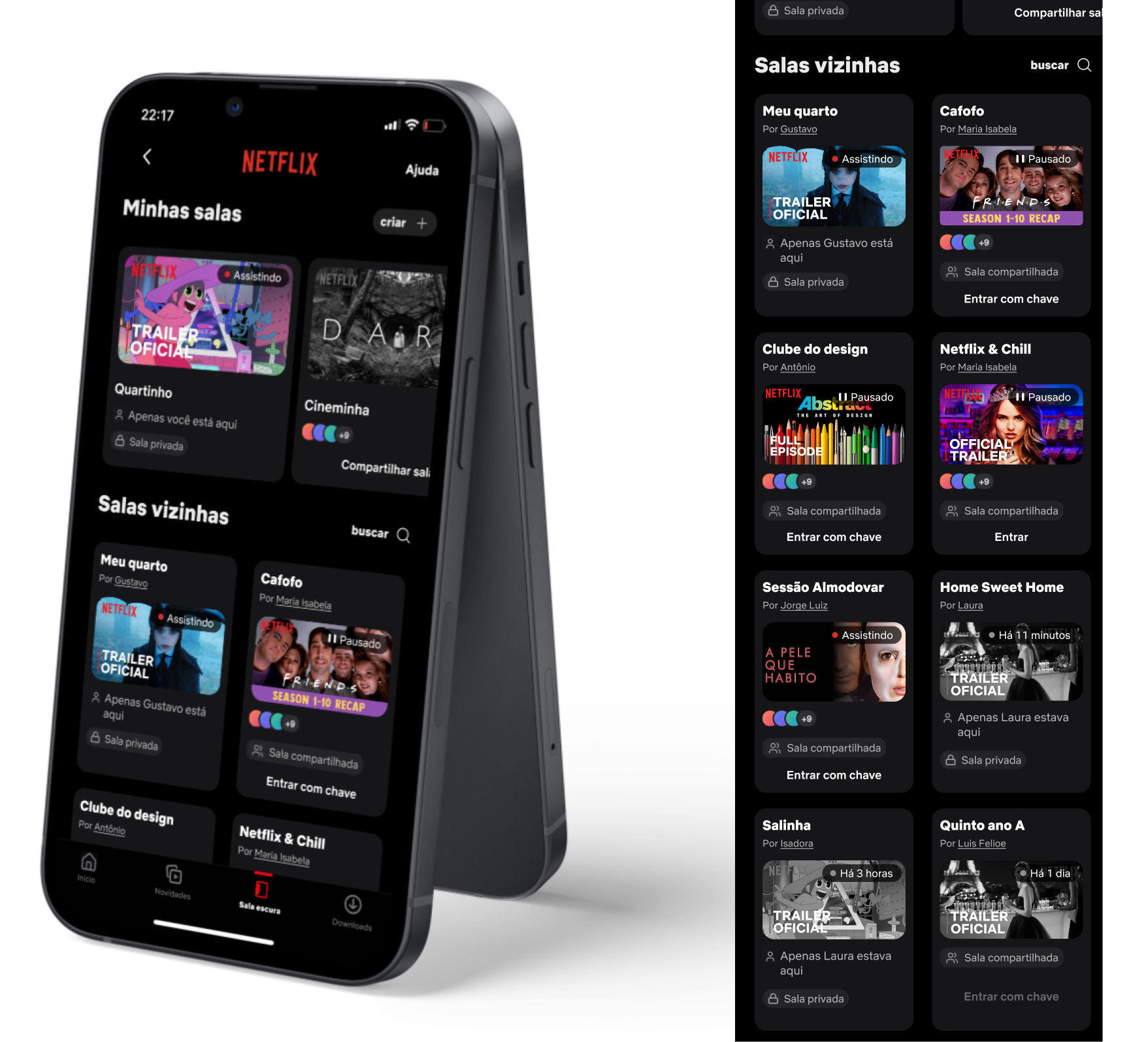
Dark Rooms, an opt-in social watching experience inside Netflix where users can create, discover, and join shared rooms to watch content together.
The feature works as a dedicated social layer inside the app. Users can create open, private, or shared rooms, invite other people, enable or disable chat, and use the mobile app as a companion experience while the content plays on TV, desktop, or mobile.
Instead of forcing social interaction across the Netflix experience, Dark Room gives users control over when, with whom, and how they want to turn watching into a shared moment.
The concept reframes Netflix discovery from only:
“What should I watch?”
to also:
“Who do I want to watch with?”
Output
Dark Room positions Netflix’s mobile app as more than a place to browse content: it becomes a gateway to shared entertainment moments.
The concept creates room for new engagement loops through invitations, recurring watch rituals, community discovery, and event-based viewing. Over time, this could evolve into monetizable experiences such as exclusive premieres, creator-led rooms, sponsored screenings, or premium room features.
The strategic value is not only making Netflix more social, but creating a scalable platform for shared watching — while keeping the core experience comfortable, optional, and user-controlled.
Context & Opportunity
The product
Netflix is a streaming platform with strong brand recognition, high usability, and recurring entertainment use. However, its experience is still mostly individual and has limited interaction between users.
The original brief proposed exploring how social features could increase engagement with the mobile app and create a stronger network effect inside the service.
The business opportunity
The streaming market is increasingly fragmented. Users subscribe to multiple platforms to cover different content needs, making the competition not only about catalog size, but also about attention, habit, and perceived value.
Netflix competes not only with other streaming platforms, but also with TikTok, YouTube, Instagram, Twitch, games, and even sleep.
This created an opportunity to explore whether social interaction could become a new reason for users to return to Netflix more often.
However, there was an important risk: social features do not automatically create value. In a streaming experience, they can also become noise, distraction, or unwanted exposure.
Investigation & Diagnosis
Suppositions
At the beginning, the main assumptions were:
- Social features could increase engagement inside Netflix.
- Users might want to interact with others around what they watch.
- Existing features such as “Fast Laughs” could be a possible entry point for social interaction.
- Mobile could be the main environment for this experience.
- A social feature could improve DAU, average time spent, and retention.
These assumptions needed to be tested because “social” is not always positive. In streaming, people often look for comfort, focus, and escape. Adding interaction in the wrong moment could harm the core experience.
Desk research
It helped framing the opportunity and the risks around social interaction in streaming.
Key finding 1: Engagement is critical for retention
In a saturated app ecosystem, recurring usage is essential. Lack of use is one of the main reasons why people uninstall apps, which makes engagement and habit formation important business goals.
Key finding 2: Netflix competes with social entertainment
TikTok, YouTube, Instagram, and Twitch compete for the same free time as Netflix. TikTok stood out as a benchmark for high engagement and average time spent, showing the strength of short, personalized, and participatory experiences.
Key finding 3: Social features in traditional streaming are underexplored
Most streaming platforms do not have strong social features. Twitch is the main exception, but its model is different because it was built around live content, streamers, communities, and chat.
Benchmark
Analyzing streaming players such as Amazon Prime Video, Twitch, Crunchyroll, HBO Max, Globoplay, Apple TV+, Looke, Mubi, NetMovies, Disney+, Viki, Pluto, Discovery+, and Netflix.
Price vs. catalog Users combine multiple streaming services to build their own entertainment bundle. Programming and catalog are still the main drivers of platform choice.
Netflix stands out in usability, but not always in catalog In interviews, users described Netflix as easy to use, but they also mentioned using HBO, Disney, Star+, YouTube, or TikTok when Netflix does not meet their content needs.
Most streaming platforms do not have strong social features This creates a potential differentiation opportunity, but it also suggests that social behavior in streaming is not obvious or universally desired.
Twitch is an interaction benchmark, but not a direct reference Twitch shows that social interaction can drive engagement, but it works because the content is designed to be live and collective. Netflix is mostly asynchronous, private, and content-first
Qualitative Research
Setup: Qualitative interviews with 6 users aged 19 to 33 to understand their streaming habits, social behaviors, content discovery patterns, and openness to sharing what they watch.
What I wanted to learn:
- When do people usually watch Netflix?
- Which devices do they use?
- Do they watch alone or with others?
- What makes them want to talk about a film or series?
- What do they prefer not to share?
- Which channels do they use to communicate with others?
- Do they know or use Netflix’s “Fast Laughs” feature?
- How could a social feature work without feeling invasive?
Key findings
Core Diagnosis
Netflix has an opportunity to create social engagement, but not by copying social networks, short-video feeds, or live-chat platforms.
The opportunity is to create chosen social moments around watching: moments where users decide to watch together, chat together, or discover content through other people.
The core insight was:
Users do not necessarily want Netflix to become social everywhere. They want control over when social interaction adds value to the experience.
Design Principles
Based on the research, the solution needed to follow four principles:
1. Optional by default
Social interaction should never be mandatory. Users who do not want it should be able to continue using Netflix normally.
2. Contextual, not pervasive
The feature should live in a specific space, not appear across the entire platform.
3. Privacy-sensitive
Users should control what they share, who can join them, and whether their activity is visible.
4. Compatible with multiple screens
Since people often watch on TV or desktop, the mobile app should work as a companion layer, not only as the main watching device.
Strategy
The strategy was to create a social experience that is opt-in, contextual, and user-controlled.
Instead of asking:
How can Netflix become more social?
I reframed the question as:
How can Netflix let users watch together without breaking the value of watching: comfort, focus, choice, and entertainment?
This helped avoid obvious but risky solutions such as:
- A permanent social feed.
- Public comments on every title.
- A chat attached to all content by default.
- A direct copy of Twitch or TikTok mechanics.
- A social feature based on Fast Laughs.
The chosen direction was to create a dedicated area for social watching rooms, with the mobile app acting as the social and management layer of the experience.
Design Concept
Dark Room
Dark Room is a social watching feature inside Netflix that allows users to create, discover, and join shared rooms to watch content together.
The idea is inspired by user-made cinema rooms: spaces created by people where others can enter, watch the same content, and interact based on shared interest or social connection.
Instead of only scrolling through the homepage looking for something to watch, users can browse rooms created by other people and enter a session because of the interaction, not only because of the content.
The experience adds a new discovery layer to Netflix:
From algorithmic discovery to people-powered discovery.
Core Experience
1. Discover rooms
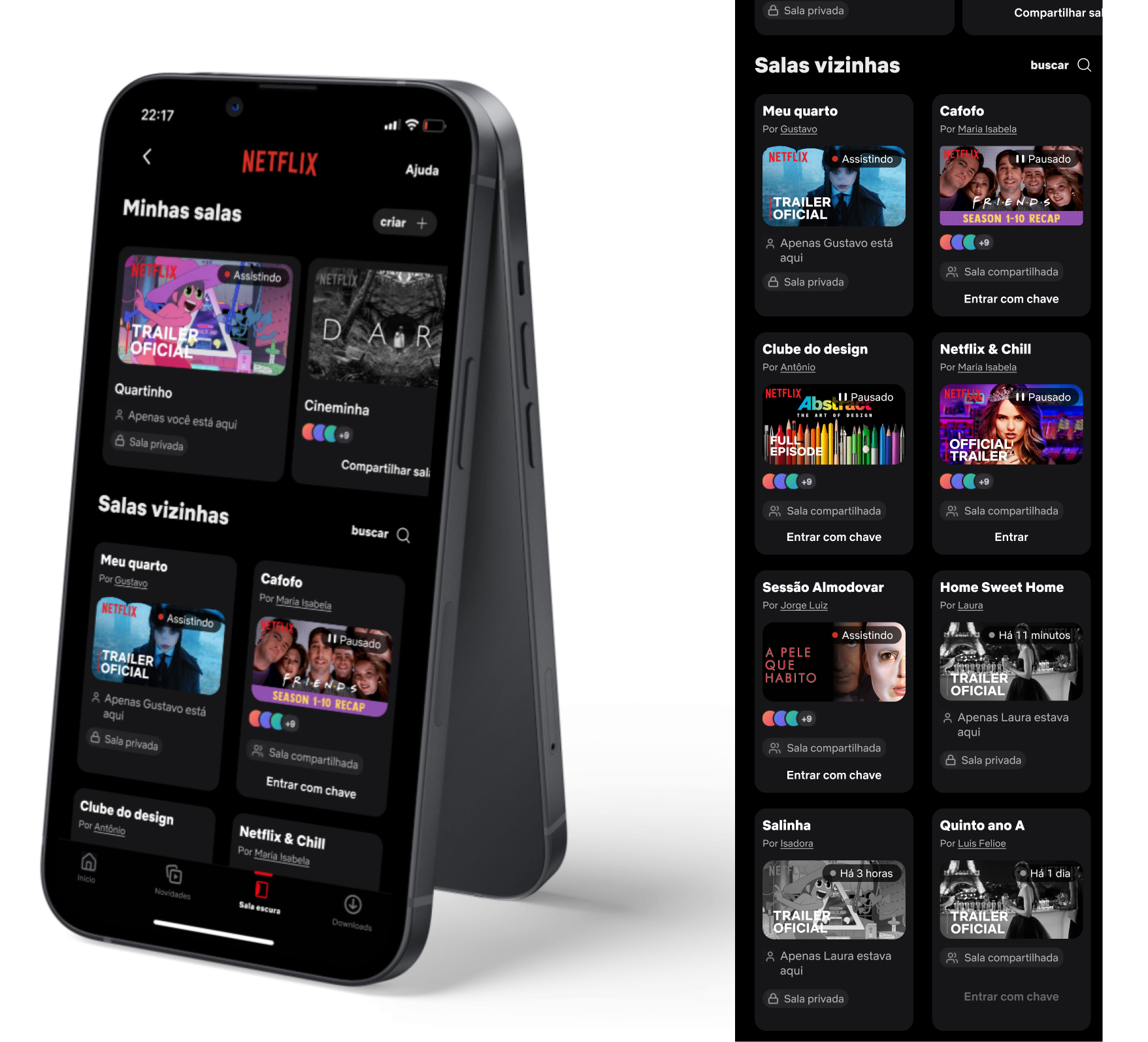
Inside the Dark Room tab, users can browse:
Their own created rooms, Nearby rooms, Open rooms, Shared rooms, Private rooms, People currently online.
What content is being watched, How many people are in each room, Whether a room is watching, paused, or waiting.
This changes the discovery logic inside Netflix.
Instead of only asking:
“What do I want to watch?”
The user can also ask:
“Which room do I want to join?”
This is especially relevant because research showed that users often watch Netflix around similar hours, mostly at night or late at night. That increases the chance of active rooms existing at the same time.
2. Create rooms
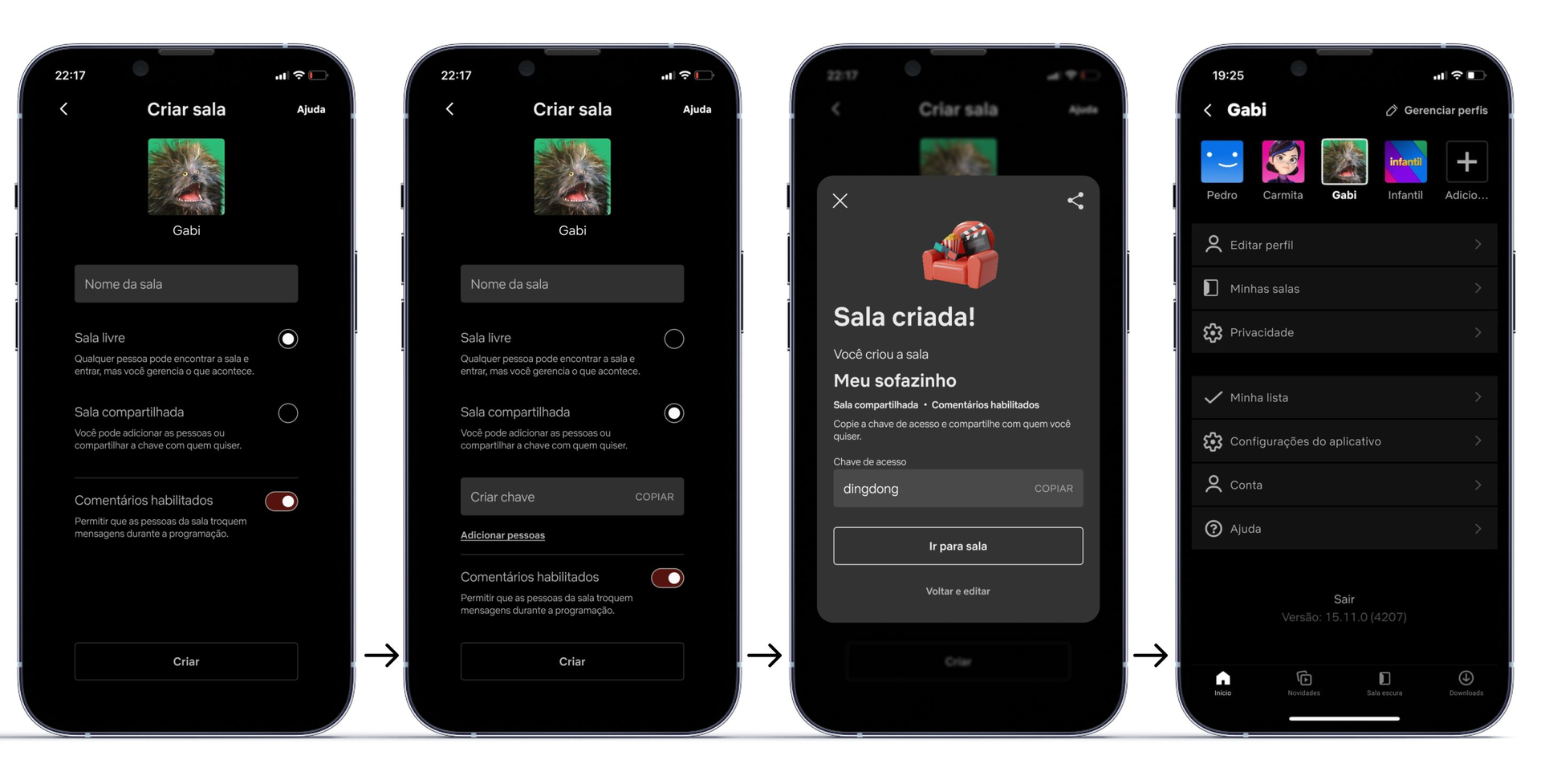
Users can create their own rooms and define their rules.
Configuration options include:
Room name, Open room, where anyone can find and join, Shared room, accessible through a key or invitation, Private room
Chat enabled or disabled, Access key for external sharing, Specific people added to the room, Ability to go back and edit settings
This protects users from unwanted exposure. The solution does not assume that every watching experience should be public or social.
Users control:
Who can join, How people can join, Whether chat is enabled, Whether the room is discoverable, Whether the experience is public, shared, or private.
4. Chat in the room
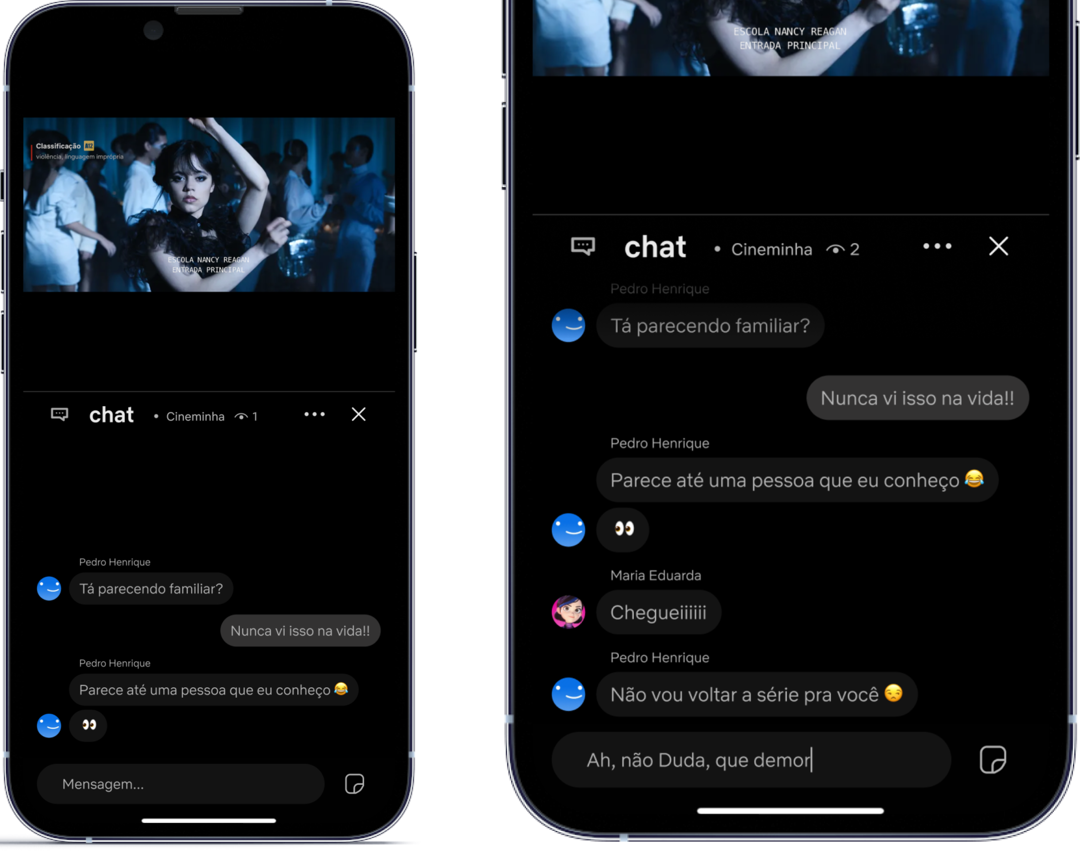
Each room can have chat enabled or disabled.
When enabled, chat allows users to talk during the session. It can be used in two contexts:
- Inside the app, when the user is watching on mobile.
- As a second-screen experience, when the content is playing on TV or desktop.
This is one of the strongest parts of the solution because it reflects the actual behavior identified in research: the smartphone is not always the main watching device, but it can be the ideal interaction layer.
The chat allows users to:
See the room name, See how many people are in the room, Manage preferences, Invite or remove members, Assign moderators, Receive visual indicators when there are new messages
Value Proposition
For users
Dark Room allows users to:
- Watch together remotely.
- Chat during a shared session.
- Discover content through other people.
- Create social rituals around films and series.
- Share experiences without leaving Netflix.
For Netflix
The solution can create value by driving:
- Higher mobile DAU.
- More sessions started from invitations.
- More time spent in the app.
- User reactivation through social notifications.
- Discovery of content beyond the homepage.
- Increased visibility of less obvious titles.
- Stronger network effects through peer-to-peer invitations.
Growth Opportunities
1. Peer-to-peer reactivation
The “Knock” feature and room invitations can act as social re-engagement mechanisms.
Instead of receiving a generic push notification, users receive a contextual invitation from someone they know.
This is one of the strongest network-effect opportunities in the solution because the motivation to return does not come only from Netflix. It comes from another person.
2. People-powered discovery
Dark Room adds a social discovery layer to Netflix.
Users can find content based on what friends, nearby users, or communities are currently watching. This creates a new path to content consumption beyond the homepage, rankings, and algorithmic rows.
This could help reduce the “I don’t know what to watch” problem and increase plays from social context.
3. Future monetization possibilities
Monetization should be treated as a future exploration, not the core value proposition of the MVP.
Potential paths include:
- Advanced room capabilities.
- Larger rooms.
- Recurring rooms.
- Special premiere rooms.
- Creator-led or event-based sessions.
These ideas would need careful validation to avoid making Netflix feel too similar to Twitch or turning a comfort-driven experience into a performative social platform.
Metrics and Validation
Because Dark Room is a conceptual proposal, success would be measured through hypotheses around engagement, discovery, and experience quality.
1. Mobile engagement
We believe Dark Room can create a new reason to open Netflix: watching together.
Metrics:
- Visits to the Dark Room tab
- Rooms created or joined
- App opens after room invitations
- D7/D30 retention of room users vs. control group
- DAU/MAU among Dark Room users
2. People-powered discovery
We believe rooms can help users discover and start content through social context, not only algorithmic recommendations.
Metrics:
- Plays started from rooms
- Titles added to My List after room discovery
- Average participants per room
- Repeat participation in rooms
- Content consumption from shared or nearby rooms
3. Second-screen experience
We believe mobile can work as a companion layer while users watch on TV or desktop.
Metrics:
- Room sessions watched on TV/desktop with mobile interaction
- Chat usage during shared sessions
- Room management actions completed on mobile
- Return rate from room notifications
Guardrails
To make sure Dark Room does not harm the core Netflix experience, we would monitor:
- Playback drop-off
- Early exits from rooms
- Chat disabled after room creation
- Opt-out from notifications
- Privacy complaints, reports, or blocks
- Decrease in film or episode completion rate